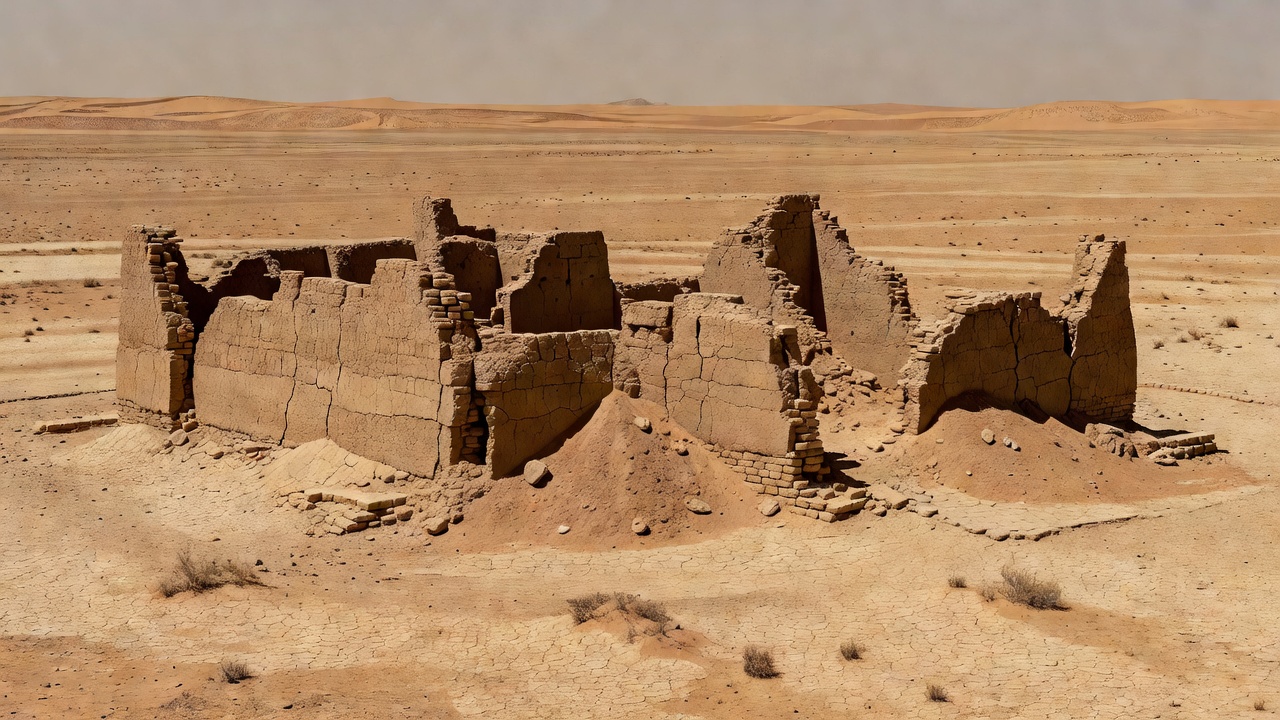
Niya: begin with the wooden document
Wooden documents recovered from the Niya region give an oasis settlement a voice that a ruined wall cannot supply. Written largely in a Prakrit language using the Kharosthi script, they record administrative and legal concerns, including obligations, property and disputes. Many belong broadly to the early centuries of the first millennium CE. Their value lies in the particular transactions they preserve, not in the promise of a complete portrait of society.
These records reveal connections between households, officials and resources. They also remind us that a place involved in wider exchange still had ordinary local problems. People needed to manage labour, resolve disagreements and maintain production. Calling such a settlement a “caravan city” can hide the agricultural and administrative work that made residence possible. A trading connection was one relationship among many.
What a desert preserves—and what it removes
Arid conditions can preserve wood, textiles and manuscripts that would decay elsewhere. This gives desert sites exceptional visibility in some kinds of historical research. It also creates a trap: a place with remarkable surviving documents may look more important than another whose records disappeared. The density of surviving evidence is not automatically the density of past activity.
Early expeditions also shaped what can now be studied. Objects and documents were dispersed among collections, and excavation methods differed from current practice. Museum catalogue entries can restore some information, but not every lost association between an object and its original context. Reading a collection therefore includes asking how it was assembled, where it is held and which details were recorded at the time.
Loulan and the changing waters
Loulan is often presented as a city simply swallowed by desert. The reality involves a difficult relationship between archaeological remains, historical names and changing water systems in the Lop Nur region. River channels, lake conditions and access to water affected settlement possibilities. Administrative and military changes also belonged to the landscape. A dramatic environmental explanation may be plausible without being sufficient.
Before accepting an abandonment story, ask what has actually been dated. A structure’s last use, the youngest surviving document and a reconstructed shift in a river may not coincide exactly. The absence of later material can result from limited excavation as well as departure. A careful account distinguishes a broad sequence from a securely established year and avoids making every family leave in one imagined moment.
Óc Eo: a delta is not a fixed coastline
At Óc Eo in Vietnam’s Mekong Delta, archaeological remains and finds have long informed discussions of early regional exchange. Imported or foreign-influenced objects point to connections extending beyond the immediate landscape. Canals and settlement features invite questions about transport, drainage and production. Yet the delta itself changed over time, so the relationship between an ancient settlement and the sea cannot be read directly from today’s map.
The proposed identification of Óc Eo with Kattigara, a place named in Ptolemy’s geographical tradition, remains an interpretation rather than a label supplied by an excavated sign. Textual coordinates, transmission problems and alternative readings complicate the comparison. A compelling geographical resemblance is not enough on its own. The archaeological site remains important even if a famous ancient name cannot be attached with certainty.
Not rediscovered from nothing
“Lost” and “rediscovered” are convenient narrative words, but they can erase people who knew a landscape before formal investigation. Local knowledge may preserve names, landmarks or stories even when those do not map neatly onto academic categories. At the same time, a long-standing local story is not automatically a precise account of an ancient event. Respecting knowledge and evaluating a historical claim are compatible responsibilities.
For readers and travellers, the strongest reconstruction keeps several layers visible: the excavated place, the name found in a document, the modern identification and the later stories attached to it. Those layers may reinforce one another, but they should not be collapsed into one seamless certainty. A settlement becomes more interesting, not less, when we can see exactly where the surviving record stops.
Uncertainty file: is abandonment the same as disappearance?
No. Activity can contract, relocate or change function. Later occupation may be hard to detect, and knowledge of the place can persist after permanent residence ends.